

Reading Cialdini Wrong

01 · The countdown timer
The head of growth presents a slide showing 14 percent conversion uplift from a countdown timer. It is the third presentation this quarter that shows uplift from a countdown timer.
It always works in the first month. That is the part that gets put on the slide. The rest of it lives in a different deck that nobody asks for, because nobody on the call has been at the company long enough to know there is a different deck.
The timer in question counts down from forty-seven minutes. It resets to forty-seven minutes if you reload the page. It also resets to forty-seven minutes if you come back tomorrow. It has been running on the site for eighteen months. The same returning customer has now seen it ninety or a hundred times. She is still buying things from the site, but she is buying them at a lower rate than she did before the timer was installed, and the lift the head of growth is presenting is computed against a control group that does not include any of her cohort.1
Nothing on the dashboard surfaces this. The dashboard is showing the number it was built to show.
If you ask the head of growth where the timer came from, she will tell you it came from the CRO playbook the agency dropped in last August. If you ask the agency where the playbook came from, they will tell you it came from a conference deck that cited a research paper. The research paper is by a psychologist named Robert Cialdini and it is from 1984.
Cialdini's book Influence is, by some accounts, the most cited text in the history of marketing. Six principles. Seven, after the 2016 update. The book has sold millions of copies and shaped a generation of growth thinking. It has also, in the digital era specifically, been gutted in a way that makes the original argument unrecognisable.
The principles work. That is not what is in dispute. What is in dispute is what they were built to do, and at what register they operate, and what the cost is of using them at the wrong one.
Cialdini gave the digital industry a set of forces. The digital industry took them and turned them into buttons.
02 · What Cialdini was actually studying
Before he wrote the book, Cialdini spent three years enrolling in sales training programmes under a fake name.
This is a detail worth keeping in mind, because it explains why the principles describe what they describe. He was not a marketing theorist. He was a social psychologist who got curious about why some sales pitches worked on him and some did not, and he decided that the literature on attitude change he was reading at the university was not actually engaging with the question he wanted to answer.
So he went into the field. Used-car lots. Insurance offices. Fundraising dialler rooms. Hare Krishna recruitment in airports. He spent the late 1970s being trained as a pitchman in places that did not know they were teaching a future ASU professor how to write the bestselling marketing book of the next forty years.
What he came back with was a taxonomy of mental shortcuts. Reciprocity. Commitment and consistency. Social proof. Liking. Authority. Scarcity. Each one named a heuristic that humans use to make fast decisions under uncertainty, and each one was something the compliance professionals he had trained with were systematically activating to drive specific outcomes. In 2016 he added a seventh principle, unity, which he had been seeing in his data the whole time but had previously folded into liking.
The book was descriptive, not prescriptive. It explained what worked and why. It also, in passages that the marketing literature has mostly ignored, drew a careful line between two ways of using the principles. The ethical use was to surface a signal that was genuinely there. The unethical use was to manufacture the appearance of a signal that was not. The first he called influence. The second he called manipulation.2
The digital industry did not inherit this distinction. It inherited the principles, stripped of context, by way of a CRO literature that was looking for things to do to checkout pages.
By the time Cialdini reached the typical growth marketer in 2014 or 2015, what survived was the seven names and a vague sense that pressing on each of them would lift conversion. The thirty years of laboratory work behind each principle, and Cialdini's own ethical framework, did not survive the journey. The framework that did survive is the one that produces the countdown timer.
03 · Two registers, one set of forces
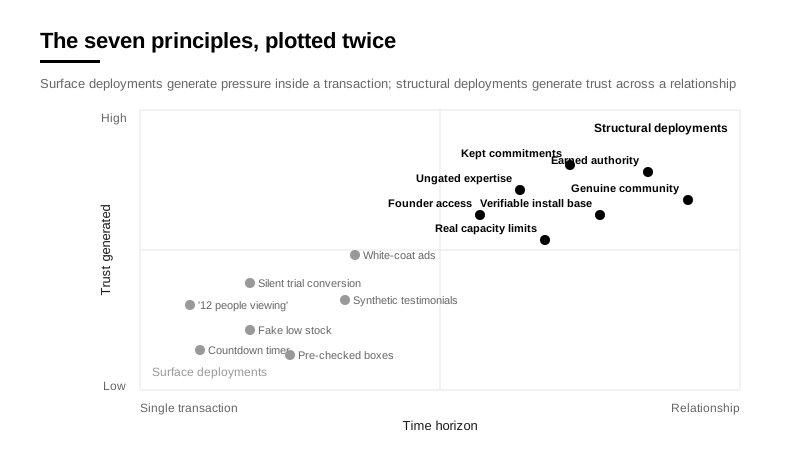
The same principle is doing entirely different work depending on whether you deploy it inside one transaction or across a relationship.
This is the central distinction this paper is built on. It is not a complicated idea. It is, however, almost entirely absent from the digital playbooks that cite Cialdini, and it is the reason why the principles get used the way they do.
Take reciprocity. The textbook example is the free sample at Costco that increases the probability you buy the cheese. It works. It has been replicated in laboratories for sixty years. The mechanism is well understood. Now consider what reciprocity looks like when it is operating inside a single transaction versus across a relationship.
Inside a single transaction, reciprocity looks like a free trial that requires a credit card up front, configured to convert silently to paid before the user reasonably expects it. The friction is engineered, the gift is conditional, and the whole structure is designed to extract a transaction the user might not have made if the terms had been visible. The technical name for this is a dark pattern. It is also, in a literal sense, reciprocity.
Across a relationship, reciprocity looks like the small consultancy that publishes detailed how-to guides for years, never gates them, never requires an email address, and is the firm you call when the problem the guides described actually shows up at your business. The gift is not conditional. The compounding effect is enormous. It is also reciprocity, in exactly the form Cialdini described.
Same principle. Two completely different time horizons. Two completely different things being built.
The same split exists for each of the other six. Authority, at the surface, is a fake doctor in a white coat in an Instagram ad. Authority, structurally, is the thirty-year-old company that has demonstrated competence so consistently that nobody questions it any more. Scarcity, at the surface, is a countdown timer that resets on reload. Scarcity, structurally, is a product roadmap with a small number of seats this quarter and a clear reason why.
In every case, the structural deployment requires you to actually possess the thing the principle activates. Real generosity. Real authority. Real scarcity. Real social proof. The surface deployment requires you to fake it. The surface deployment is faster, cheaper, easier to A/B test, easier to put on a slide, and the conversion uplift is measurable inside a quarter.
Which is why almost every digital business runs on the surface deployment, and almost no digital business builds the structural one.
04 · Sourdough
You can fake bread once. You cannot fake a sourdough starter that has been kept alive for fifty years.
It is worth dwelling on this because it explains why the surface and structural deployments are not really the same thing wearing different clothes. They are different products with different molecular structures.
Commercial yeast bread is straightforward. You buy a packet of yeast, you mix it with flour and water, you wait a few hours, you bake. You get bread. The bread is fine. The bread is also, for chemical reasons, slightly different from sourdough bread. The flavour profile is shorter. The crumb is more uniform. The texture lacks something that experienced bakers can identify but cannot easily name.
Sourdough is different. It is a wild fermentation, fed by a starter that is, in effect, a cultivated colony of specific bacteria and yeasts. The starter takes weeks to establish. It can take years to develop the characteristic flavour of a mature culture. Once you have one, it can be kept alive indefinitely, and the flavour deepens over time in ways that cannot be replicated by any combination of commercial ingredients.
If you wanted to fake a sourdough loaf in a single transaction, you could. There are vinegar-based additives that mimic the tang. The bread would pass casual inspection. A baker who eats sourdough every day would identify it as fake within one bite, and would not buy from that bakery again.
The Cialdini principles, deployed across a relationship, are a starter culture. Deployed in a single transaction, they are a vinegar additive.
Both produce something that looks like the same product. Both can be A/B tested against a control of nothing at all and shown to work, in the narrow technical sense of producing a measurable result. Only one of them compounds. The other one degrades the customer's ability to taste.
05 · How widespread the surface deployment actually is
If this were a marginal practice, the rest of this paper would not need to exist. It is not a marginal practice.
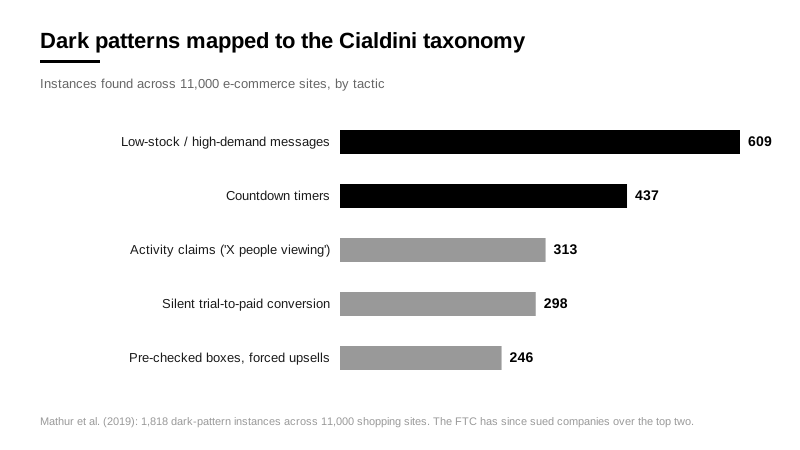
The clearest snapshot is the Princeton/UChicago crawl by Mathur and colleagues in 2019. They scanned 11,000 e-commerce sites and identified 1,818 instances of dark-pattern tactics that map directly onto the Cialdini taxonomy. Scarcity was the most common, with 609 sites running low-stock or high-demand messaging and another 437 running countdown timers. Social proof was next, with 313 sites running "X people are viewing this" or similar activity claims. Reciprocity, in the form of free trials engineered to convert silently to paid, was used by an estimated 298 sites. Pre-checked boxes, forced-action upsells, and other commitment-and-consistency dark patterns appeared on 246 sites.3
The 2024 follow-up by the FTC and ICPEN looked at 642 subscription services across 26 countries and found that 76 percent used at least one of these tactics, with 67 percent using more than one. The associated GPEN review of privacy interfaces found that 97 percent of sites and apps used at least one dark pattern when users were trying to make privacy-protective choices.
These are not numbers from one industry or one geography. They are the baseline rate of how the digital economy currently configures itself.
The reason this is not just a question of taste is that some portion of the surface deployment is now legally exposed. The FTC sued Amazon in 2023 for cancellation flows that obscured how to leave Prime. It sued Adobe in 2024 for similar conduct around its Annual Paid Monthly subscriptions, and named two executives individually. The Click-to-Cancel rule was finalised in October 2024 and struck down by the Eighth Circuit in July 2025 on procedural grounds, but the FTC has continued enforcement under Section 5 and ROSCA, and California, Colorado, and Texas now have explicit dark-pattern provisions in their privacy laws.
South Korea's E-Commerce Act took effect in February 2025 and the FTC there has now imposed fines on subscription operators in the OTT, music streaming, and commerce sectors. The EU's Digital Services Act has been live since 2024. The direction of regulatory travel is unambiguous. The question is not whether the surface deployment of the Cialdini principles will be constrained by law. It is which constraints land in which markets and on what timeline.
If you are running a digital business, the cost of the surface deployment is no longer just the gradual erosion of customer trust. It is also a non-zero probability of being named individually in an FTC complaint.
06 · Why the timer stops working
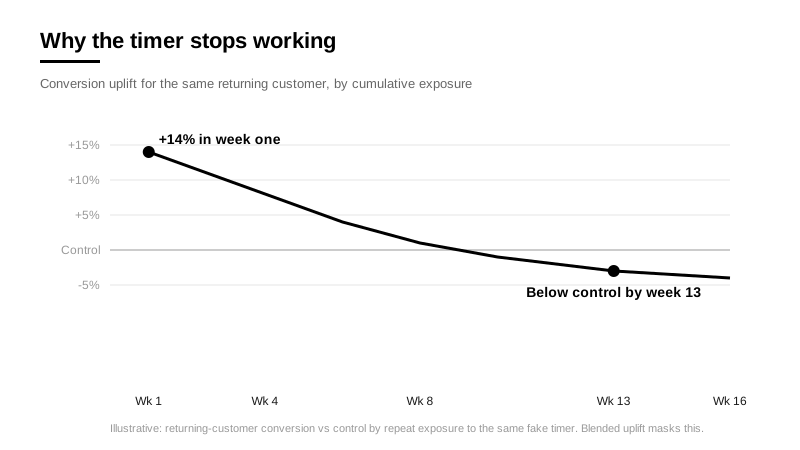
The countdown timer that lifts conversion 14 percent in week one converts the same returning customer at less than control by week thirteen.
This is the part that breaks the standard CRO defence. The defence runs: the timer is tested, the test produced lift, the lift is real, what is your problem with this. The problem is that the lift is measured at the cohort level over a window short enough that the same returning customer has not yet learned the timer is fake.
By the third or fourth exposure, the customer has learned. By the tenth, the customer is treating the timer as a noise floor. By the thirtieth, the customer is conditioned to associate the brand with the kind of pressure tactic she encounters on websites she does not trust.
None of this is detectable in a standard A/B test, because standard A/B tests are run against a contemporaneous control. The customer who has been seeing the timer for six months is comparing the timer-on experience to her memory of the timer-off experience, which the test does not capture. The customer who has been seeing the timer for two years is comparing the brand to its competitors, none of whom are running timers, and is silently shifting her consideration set.4
This is, structurally, the same problem as the brand cut. A measurable, defensible decision in the short term that produces a slow, invisible degradation in the long term. The same governance failure too. The CRO team has a quarterly target. The decay shows up at month thirteen at the earliest. The CRO lead has, on average, been promoted, replaced, or moved to a different portfolio company by then.
Nobody who runs the test owns the consequence. So the test runs.
07 · What the structural version looks like
The structural deployment of each principle is built over years and is not portable between businesses in the way a CRO playbook is. There is no how-to. There is, however, a recognisable shape.
Reciprocity, structurally, is publishing useful work without expecting anything back. The customer remembers, decides on her own when she has a problem, and arrives without being asked. One piece of useful free work has a half-life measured in years. A free-trial-converts-to-paid email has a half-life measured in days, and goes to spam after the third one.
Commitment is keeping public commitments over long periods. The product roadmap that ships on time. The pricing page that has not silently changed for two years. The CEO post about a strategic direction that the company is still pursuing eighteen months later. Each is a small public bet that compounds when it pays off. The surface version is a pre-checked box, and the only commitment in the room is the one the interface engineered the customer into.
Authority and scarcity travel together at the structural register, because both require you to actually possess the thing you are claiming. Authority is a fund that has compounded for two decades, or a technical team that has shipped the hard thing nobody else could. Scarcity is the manufacturing line that genuinely cannot produce more, or the advisory firm that takes six new clients a year because that is how many partners it has. The surface versions are an actor in a white coat and a pop-up that says only three left, resetting to three on reload.
Social proof, structurally, is an install base whose existence is independently verifiable. The case studies the customers themselves wrote. The long-tail testimonials nobody asked for. The surface version is a notification that says twelve people are viewing this product right now. The number is generated by a random function and the customer increasingly knows it.
Liking and unity are both about who the customer feels they are dealing with. Liking, structurally, is the founder who answers email and the support team empowered to fix things without three escalations. Unity is the customer base that genuinely shares an identity with the business and with each other, the Patagonia customer who knows the company does what it says about repair and reuse. The surface versions are a personality quiz with a synthetic testimonial, and a Slack workspace called The Inner Circle that anyone can join in two clicks where nothing happens.
The structural version of each principle is harder to build, slower to measure, and boring to write up in an investor letter.
It is also, in every case I have watched closely, the version that produces the businesses people quietly trust.
08 · Why almost nobody builds for the structural deployment
Because the people who would have to build it are not the people whose tenure is long enough to see it pay off.
This is the same governance pattern that produces the brand cut, the CAC drift, and most of the structural underinvestment in the venture and PE-backed digital economy. It is worth naming explicitly because the response to this paper, in some quarters, will be that the structural deployment is impractical or commercially naive.
It is not impractical. It is impractical inside the specific incentive structure that runs most digital growth functions, which is a quarterly target attached to a person whose average tenure in the chair is shorter than the payoff window of the structural deployment.
Take the head of growth from the opening of this paper. Average tenure in seat: maybe twenty months in a venture-backed business, often shorter in PE. Her bonus is keyed to conversion lift on a quarterly cadence. The countdown timer ships in week three of her tenure and produces measurable uplift by week six. The decay starts being detectable around month thirteen, by which point she is either negotiating her exit or has already left for a similar role at a different company. The successor inherits a CAC trend that looks structural and a customer base that is more brittle than the dashboard suggests.
There is no point in this sequence at which any individual was rewarded for the structural deployment, and there is no point at which any individual was punished for the surface one. The behaviour the system produces is exactly the behaviour the system pays for.
The same is true at the agency layer, at the platform layer, and at the layer of the third-party CRO tooling vendors whose entire product is the surface deployment of one or two of the principles. Hotjar, Unbounce, OptiMonk, the dozen smaller competitors that ship countdown timers as a checkbox feature. None of these are bad companies. They are honestly serving the demand their customers have, which is for tools that produce measurable lift inside a quarter. The structural deployment does not have a SaaS vendor because it is not a feature you can install.
It is something a leadership team builds for, slowly, over years, against the pressure of every quarterly review.
Which means the question of whether a digital business runs on cheap influence or structural influence is, in the end, a question about who runs it and what time horizon they are paid against.
09 · The part I cannot prove
It is hard to separate the contribution of structural Cialdini from the contribution of just having a good product.
The businesses I have in mind, the ones that compound on reciprocity-as-position rather than reciprocity-as-tactic, also tend to have above-average products. The customer base that returns is returning partly because the trust signals are real, and partly because the thing they bought last time was good. I do not have a clean way to disentangle these two contributions, and I am not sure one is possible.5
The strongest version of the case I am making is that the structural deployment of the principles and the underlying quality of the product are not separable in the first place. The principles are not a marketing layer on top of a product. They are a description of what the product feels like across a relationship. A product that is genuinely good will, by definition, generate real social proof, real authority, real reciprocity. A product that is mediocre cannot manufacture these from a CRO playbook, and the attempt is what produces the surface deployment.
If that is right, then cheap influence is not a marketing choice. It is a tell. It tells you that the underlying product cannot generate the signals on its own, and that the marketing function has been asked to fake the signals to compensate.
The version of this I am most confident in is the negative one. Surface-level deployment of the principles, sustained over enough years, actively undermines the customer's ability to read the structural version when it does show up. We have trained an entire generation of consumers to discount the principles when they encounter them, because they encounter them so often as smuggled signals.
That is a bigger problem than any one CAC bridge.
Conclusion: the starter or the additive
Cialdini's principles are not a bible. They are not a toolkit. They are a description of how humans process social signals under uncertainty, which is the situation almost every digital customer is in almost every time they transact.
The principles are going to operate on your customer whether you invoke them deliberately or not. Reciprocity is in the room. So is authority, scarcity, social proof, all of it. The only question is whether the signals your business is generating are real ones the customer can verify over time, or manufactured ones the customer will eventually learn to discount.
If you build for the structural deployment, you have something that compounds. Customer trust deepens with each transaction. The marketing layer becomes thinner over time because the product is doing the work the marketing used to do. Acquisition cost drops because referral, organic, and direct become a larger share of the mix. None of this shows up in a quarter. All of it shows up in the eventual exit multiple.
If you build for the surface deployment, you get the opposite. A quarterly conversion uplift that decays in cohorts you are not measuring. A regulatory exposure that is growing every year. A customer base that is, slowly, learning to read your interface as the interface of a company that does not believe in itself enough to put a real signal in its place.
Most of the digital industry will continue to run the surface deployment. The incentive structure makes it inevitable. The dashboards make it inevitable. The CRO tooling vendors make it inevitable. The handful of digital businesses that compound at the multiples everyone in the industry talks about wanting are the ones who, somewhere in their early history, decided that the structural version was the only one worth building for.
The principles are not the issue. They have not been the issue for forty years. What you do with them is.
The principles describe how customers process social signals under uncertainty. The digital industry inherited them as buttons to press. Forty years later, the customer can tell.
Notes
- Yes, there are CRO programmes that use these tactics with hard-coded exposure ceilings and produce defensible long-run uplift. I have seen two of them. The version that gets shipped at scale is the one I am describing.
- Cialdini himself is more explicit about ethics than the literature inherited from him. He distinguishes "detectives" (who use the principles to spot when others are using them on us) from "smugglers" (who use them while concealing the underlying signal). The digital industry has spent fifteen years writing case studies for the smugglers and calling it growth.
- There is an honest version of this argument that says scarcity-style messaging, even when artificial, may produce small permanent shifts in market structure that benefit the first mover. I do not think the evidence supports this in categories where customers transact more than once a year, but I want to flag it because it is the case I would make if I were defending the practice.
- The Mathur et al. study is from 2019. The patterns they catalogued have become more sophisticated since, not less. Several have been outlawed in specific jurisdictions. Most have not.
- This is the part I am least sure about. It is hard to separate the contribution of structural influence from the contribution of just having a good product. The businesses I have in mind that get this right also tend to have above-average products. I have not seen a clean enough natural experiment to settle the causal question, and I am not sure one is possible.
perspectives

The Business Underneath

How to Build a Modern PE Firm