

The Business Underneath

01 · Two roofers
There are two roofing companies in a county we know well. Same trade, same materials, same twenty-year warranty. One of them does roughly four times the revenue of the other.
The one doing four times the revenue is not the better roofer. We want to be clear about that up front, because the whole thing turns on it. Put the two crews on the same roof and you would struggle to tell the work apart, and on a bad day the smaller operator does the finer job, because he has been doing it for thirty years and he still cares about the flashing in a way the bigger outfit stopped caring about the day it had six crews to keep busy.
What the bigger one does better is get found. He answers the phone before it rings twice. He has a few hundred reviews sitting at 4.8, most of them from the last ninety days. When somebody in that county types their town and the words roof repair into a phone at nine at night, he is in the little box at the top of the map. The better roofer is on page two, if he is anywhere at all.
The better roofer has eleven reviews and a website his nephew built in 2016. He is losing, and he cannot tell you why, because he is still keeping score on roofs. Ask him what business he is in and he will tell you the roofing business. He has been in it his whole life, he is proud of it, and he should be. He is also being beaten inside his own trade by a man whose roofs are no better than his, and he has no idea what game he actually lost, because nobody keeps a scoreboard for it and he has never once seen the numbers that would show him.1
So ask the other question. What is the winning roofer actually good at. It is not roofing. They are both good at roofing. He is exceptional at something else, something he could not name if you put him on the spot, and something that appears nowhere on his own profit and loss.
He is winning at a thing he cannot name, that sits on none of his own accounts. That is the thing worth naming.
02 · The data does the naming
Around 98 percent of people search online before they hire a home-services business. By the time anyone picks up a phone, the decision is mostly made.
The rough numbers are not subtle. Something close to 98 percent of home-services customers run a search before they hire. About 84 percent of homeowners go through Google before they choose a contractor. For roofing on its own it is a little over half, which is lower than you would expect until you remember how many roofs get sold off a knock at the door after a storm. The point holds either way. The customer builds a shortlist, and mostly reaches a decision, before a single person has demonstrated a single roof.
This is the moment somebody in the room says Theodore Levitt. Marketing Myopia, 1960, the railroads. The railroads thought they were in the railroad business and not the transport business, so they watched trucking and air freight take their lunch and called it bad luck. Fine. It is a good essay and everyone who runs anything has read it.
But Levitt was handing you an instruction to think bigger. Widen your definition of the market, he said, and you will see the threat coming. Good advice, and still a guess. He was asking the railroad men to imagine harder about what business they might be in. He could not give them the answer, because in 1960 there was no instrument that could.
There is one now. That is the whole difference, and it is not a small one.
Put proper measurement on a home-services business and you are not asking anyone to imagine anything. The funnel reports back. It tells you, with a number attached, which lever actually moves the revenue and which ones you have been fussing over for no return. Levitt told you to broaden the question. The data closes it.
And the answer it keeps returning, in category after category, is that most of the distance between a good month and a bad one traces to how the business gets found and chosen, and very little of it traces to how well the work gets done. Become genuinely exceptional at the finding and the choosing and you can move the majority of the business. Get ten percent better at the actual roofing and almost nothing happens, because the customer cannot see the roof before they buy it and has no way to reward you for it.2
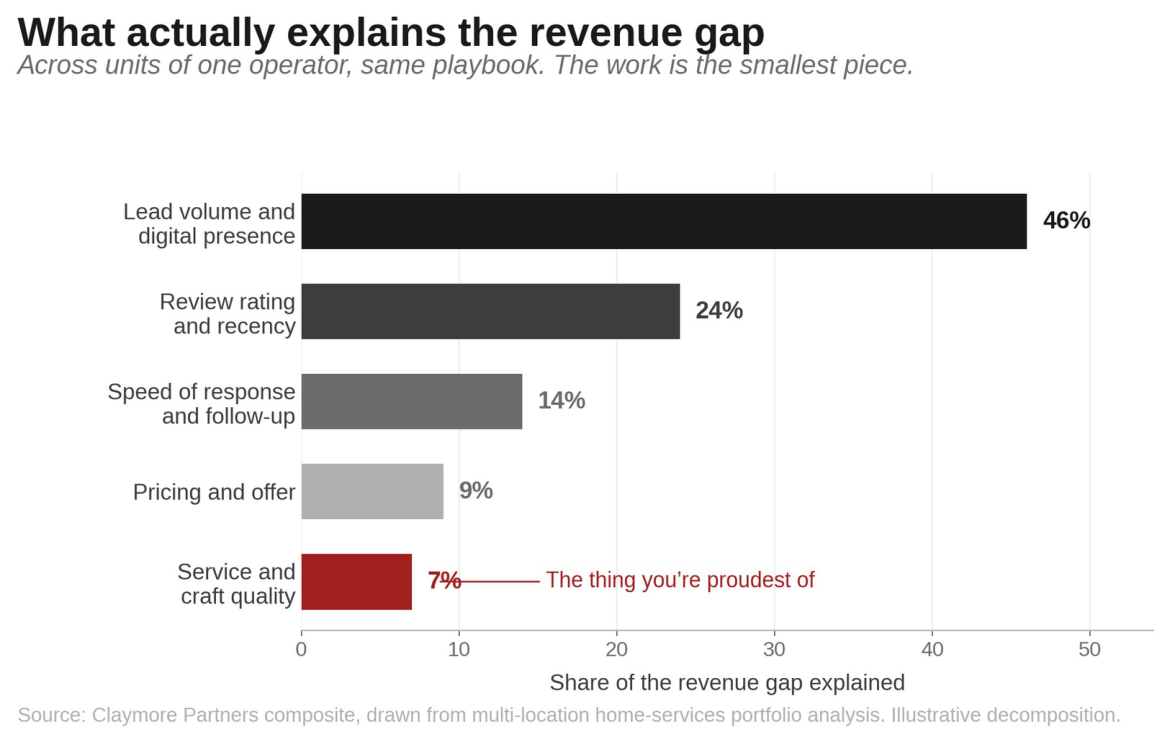
Which raises an awkward question about the org chart. The lever that moves the business is real, it is measurable, and in most of these companies nobody owns it.
03 · The reputation premium
A one-star improvement in your rating moves revenue somewhere between five and nine percent. A better crew moves it by nothing the customer can see before they pay.
That five-to-nine-percent figure is not ours. It comes out of a Harvard study of Yelp data, and it has held up because it measures the thing that actually happens. The market cannot inspect your work before it hires you, so it uses your rating as a stand-in for your work, and it pays real money on the strength of the stand-in.3
So the roofer with two hundred recent reviews and a 4.8 beats the better roofer with eleven. Not because the market is stupid. Because the market is doing the only rational thing available to it. It cannot climb onto the roof and check the flashing. It can read what two hundred other people said, it can see that eleven is not two hundred, and it decides on that.
Anyone who has ever hired knows the shape of this. The most capable person in the pile does not always get the job. The one with the cleaner CV and the three strong references gets the job, because the panel cannot watch either of them work before deciding, and a reference is the only evidence in the room. The better candidate loses to the better-documented one, and calls it unfair, and is right, and loses anyway.
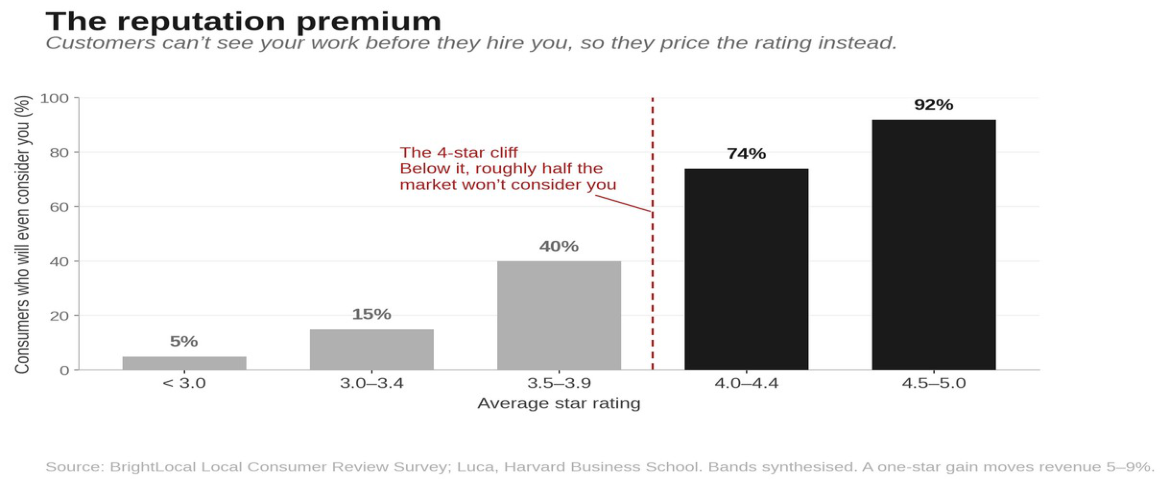
You can be the best operator in the county and lose, and the thing that beats you is a number on a screen that no one in your building is responsible for.
04 · The org chart is upside down
Run this across six different trades and the same answer keeps coming back.
The roofer is not a special case. He is only the easiest one to see, because a roof is such an obviously physical thing to sell. Put the same instruments on any local business that lives on a steady flow of customers and the same pattern shows up. The trade on the sign is the thing being sold. It is almost never the thing that decides whether the business wins. What decides that sits one layer underneath, in how the customer is found, chosen and kept, and until digital arrived there was no way to see it clearly enough to act on. Now there is, and once you can measure it you cannot unsee it.
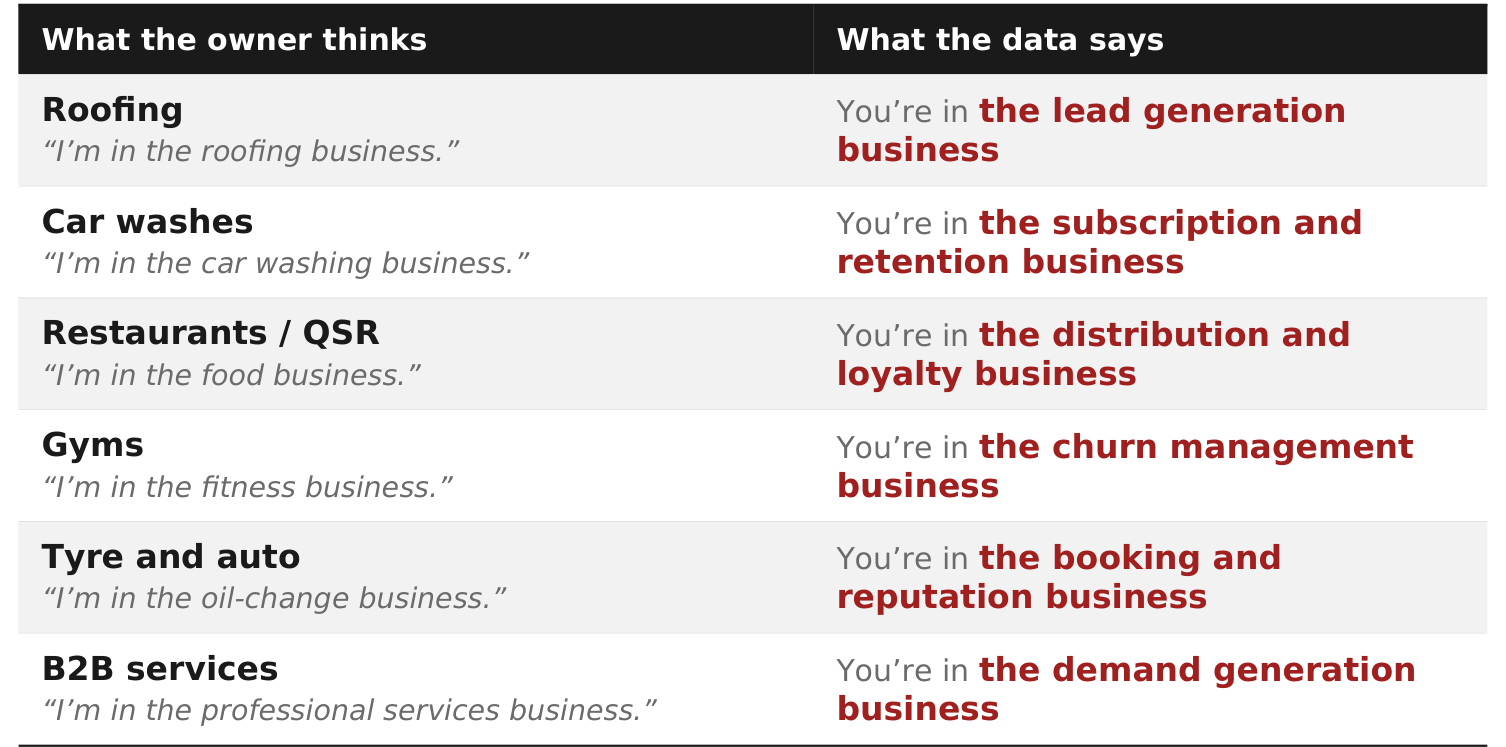
Take the car wash. The owner believes he is selling clean cars, so he spends his money on better brushes, stronger chemicals and a faster line. Instrument the business and the picture changes. The money is in the unlimited monthly membership, and the whole game is how many people sign up and how long they stay before they cancel. The wash itself is the cost of holding the membership, not the product. Two sites with identical equipment can run a thirty-point gap in profitability, and the gap lives entirely in how the membership gets sold at the point of purchase and how the cancellations get handled. The operator polishing his brushes is losing to the one who worked out he is running a subscription business that happens to get cars wet.
Or the gym. Everyone already knows, if they are honest, that a gym makes its money from the members who pay and do not come. That is not a scandal, it is the model. Which means the business is not fitness. It is a recurring billing relationship, and it lives or dies on churn. The lever that moves a gym is what happens in a new member's first six weeks, because that is what decides whether they are still paying in month nine or have cancelled and told three friends the place was a con. The squat racks matter, but nobody ever left because the squat rack was slightly worse. They left because nobody noticed they had stopped coming until the direct debit bounced.
Or tyre and auto. The oil change is a commodity and the customer knows it, so the operator competes on price and wonders why the margins are thin. The data says something else. This is a business about being the name the customer thinks of when the warning light comes on, and being easy to book the moment they do. The lever is the reminder that lands before the light, the booking that takes fifteen seconds, and the review score that makes you the safe choice when a stranger is deciding who to trust with their brakes. The bay that changes the oil fastest is not winning. The one that owns the reminder and the reputation is.
Six trades, one shape. Whatever the sign says, the business underneath is the finding and the keeping, and the operator who gets exceptional at that eats the ones still perfecting the thing on the sign.
Here is what that does to the org chart, and it is the part most owners have never looked at squarely. The thing that decides the revenue, finding the customer and keeping the customer, sits at the bottom of the building. It is run by whoever is cheapest, or farmed out to an agency on a retainer nobody reviews, or it lives in the founder's own head and personal logins and carries no job title at all. The thing that is the cost of doing business, the actual trade, sits at the top, with the most senior people, the corner offices, and nearly all of the owner's attention.
The profit centre is being run by a junior, an outside vendor, or nobody. The cost centre has the best people in the company and most of the boss's week.
Newspapers did exactly this for a century and it eventually killed most of them. They believed they were in the news business, so the newsroom got the talent and the prestige and the top floor, and the classified section, the small ads at the back that nobody was proud of, got treated as plumbing. The small ads were the business. The news was the expensive thing they produced to gather the attention they then sold. When Craigslist came for the classifieds it was not coming for a side line. It was coming for the actual company, and the actual company was defended by no one, because everyone who mattered was upstairs writing.
Every improvement you make to the trade at the top of the chart makes the company better at what it does and does nothing for what it earns. That should bother you more than it does.
05 · What you actually bought
You buy the roofing company. You pay a roofing multiple. You have just bought a lead-generation machine with a roofing cost centre bolted to the side, and you priced the wrong half.
This is where it stops being a marketing problem and becomes a diligence problem, which is to say it becomes expensive. At entry you counted the things that count easily. The trucks, the crews, the backlog, the signed contracts, the equipment on the fixed-asset register. All of it real, none of it the engine. The engine is the thing that fills the backlog in the first place, and you did not put a number on it, because it does not sit on any register you were handed.
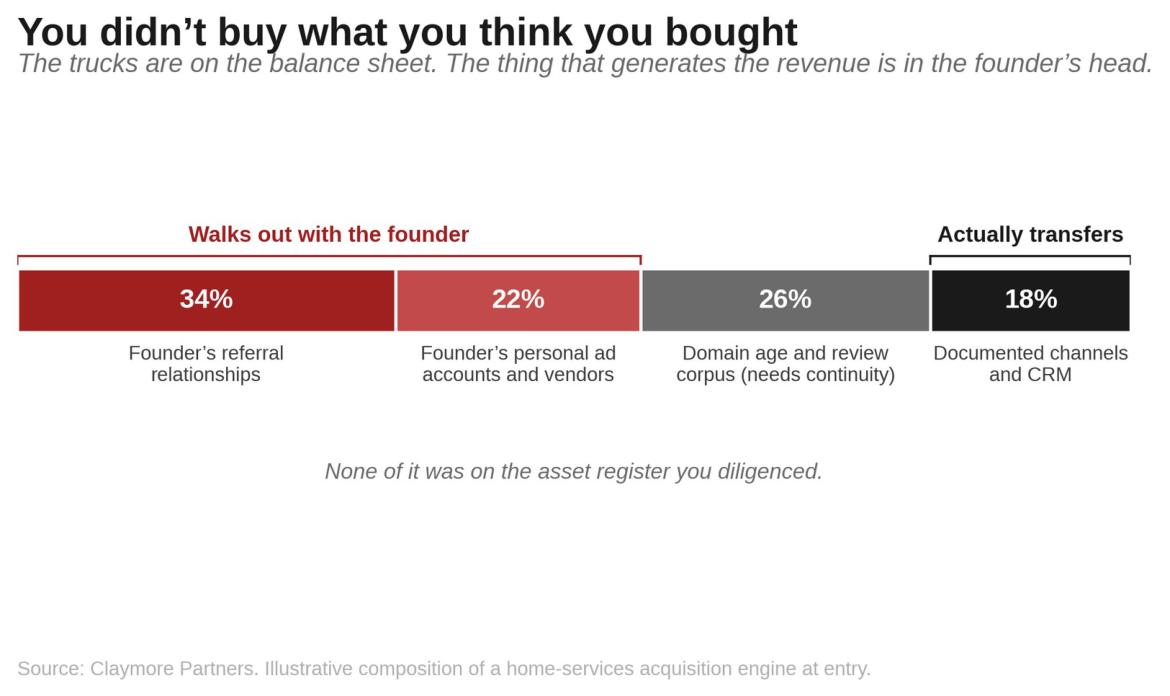
Worse than not pricing it, you usually cannot own it. Pull the machine apart and most of it turns out to be the founder. His fifteen-year-old domain and the search ranking that came with age. His personal Google account with the ad history that makes the auction cheap for him and dear for everyone else. The three referral sources he has taken to lunch every quarter for a decade. The review corpus, built one satisfied customer at a time, that no amount of money reproduces quickly because the one thing it needs is years.4
So you do what the playbook says. You professionalise. You put in a real CRM, you tighten the operations, you bring in an experienced general manager, and you let the founder take his earn-out and his boat and go. Six months later the leads have thinned and the CAC is climbing and nobody in the building can say why, because the thing that generated the leads was never written down, never sat in a system, and left in the founder's car.
You improved the cost centre and quietly severed the profit centre, because at no point did anyone establish which was which.
The question that would have caught this is not the one on the diligence checklist. The checklist asks how good the operation is. The question that matters is where the acquisition engine lives, who owns it, and whether it is still running the day after the founder leaves. If the honest answer is that it lives in his head and his personal accounts, you are not buying a business with a moat. You are buying a book of relationships with an expiry date on it, and you can either price it that way going in or fix it before the man who is it decides to leave.
The diligence that would have surfaced this is not the diligence that gets a fund comfortable enough to write the cheque, which is exactly why it does not get run.
06 · The machine, not the channel
Google is already slipping. In a single year, the share of people using AI tools to find local businesses went from 6 percent to 45 percent.
The channels are moving under everyone's feet, and faster than the people who built their whole business on one of them have understood. Google's grip on local discovery is loosening. A large slice of it has gone, in about a year, to people asking ChatGPT and Gemini and the rest which plumber they should call. Anyone whose entire lead flow is a Google ranking he has tuned for a decade is about to find out how much of what he built was portable and how much was rented.
This does not weaken the argument. It is the argument. If you thought you were building a Google machine, the shift is a crisis, and you will spend next year in a panic buying whatever the vendors are now calling AI search optimisation. If you understood all along that you were building an acquisition machine, the shift is a Tuesday. You add a channel, you test it, you move budget toward what converts, you carry on. The machine was never the channel. The machine is the discipline of treating every channel as a test you already expect to change.5
The direct-mail operators of the 1990s split into two groups, and it matters which one you are in. One group believed they were in the direct-mail business, and when the post stopped working they went down with it, still arguing that a good letter beats an email. The other group knew they had never been in the direct-mail business at all. They were in the business of finding a customer for a known cost and a known return, and the post was just the pipe that happened to carry it that year. They moved the same discipline to email, then to search, then to social, and they are the ones still standing, running the same playbook through a fourth pipe, entirely untroubled that the third one died.
The machine is portable across every channel that will ever exist. The years you spend not building one are the only thing that is not.
Conclusion: the window
The reframe is worth a fortune right now for one reason. Most of your competitors still think they are roofers.
That is the whole opportunity, and it will not last, so we will say it plainly. The reason a data-driven operator can walk into a fragmented trade and take it apart is that almost everyone else in the trade is still keeping score on the work. They are proud of the work, they are good at the work, and they are measuring the wrong thing while a man who has never held their tools eats their market by being exceptional at the part they treat as beneath them.
That is an arbitrage, and arbitrages close. As data-driven reframing spreads through a category, everyone crowds onto the same lever, the cost of a lead climbs, and the edge compresses back toward the things that are hard to copy: a genuinely good product and customers who do not leave. Which is the other half of this, and we are not going to pretend it away. The reframe tells you where to point your effort. It does not give you licence to let the actual work rot. A brilliant lead-generation machine aimed at a bad product just fills the funnel with people who leave one-star reviews, and then the machine turns on you, because the reviews were the machine.
You still have to fix the roof. You just have to stop believing the roof is the business.
So the work for the operator reading this is not complicated, and it can start this quarter. Read your own business the way the data reads it, without the sentiment. Find the single lever that explains most of the gap between your good months and your bad ones. Then look at your org chart and find the person who owns that lever.
If the answer is that nobody owns it, you have just found your biggest risk and your biggest opportunity written on the same line.
Notes
- The better roofer is not always doomed. If his referral base is deep enough and his market is small enough, word of mouth can carry him for years. The problem is that a referral base is a fixed stock, not a machine. It ages, it moves away, it dies, and he has no way to refill it at the rate a younger competitor is filling his. He is living off capital and calling it income.
- We are most confident of this where the funnel is short, frequent and measurable, which is exactly where home services lives. It gets less tidy where the purchase is rare, relational and high-consideration, and where the product genuinely is the differentiator. Some complex B2B, some regulated categories, the top of the luxury market. The data still helps there. It just does not always hand you one clean lever, and we are not going to pretend it does.
- The honest objection is that better businesses earn better reviews, so some of that revenue lift is the business being good rather than the stars doing the work. True. It does not rescue the roofer. The market still acts on the visible proxy, and the better operator with the thinner review file still loses the job to the lesser one with the fuller file. The causation runs both ways. The customer only ever sees one direction of it.
- The cruel part is that the founder often cannot hand the machine over even when he wants to, because he could not tell you how it works either. He knows the three people to call and the feel of a good week. None of it is written down, most of it he has never put into words, and an earn-out cannot buy knowledge that was never made explicit. You are not being cheated. You are inheriting something that was always tacit and is now walking to the car park.
- The firms about to sell you AI search optimisation as a thrilling new discipline are selling you a channel and calling it a strategy. The discipline is the one you should already have had: test the channel, measure the return, move the budget to what converts. If you have to buy that as a bolt-on, the thing you are actually missing is not on ChatGPT's side of the transaction.
perspectives

How to Build a Modern PE Firm

The Claymore Way